Dependency Intelligence: How Skillsmith Infers What Your Skills Need
Skills reference MCP servers, models, and other skills — but until now, users had no way to know what a skill actually needs. Skillsmith's new dependency intelligence layer combines author declarations, static analysis, and behavioral data to surface dependencies before they become failures.
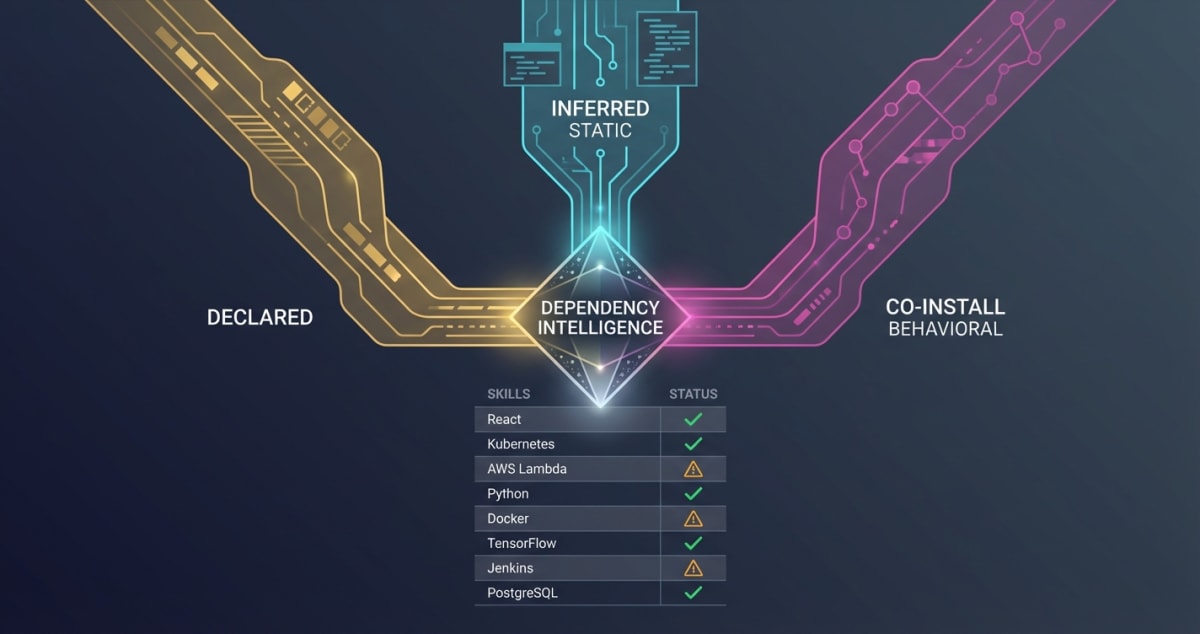
A governance skill calls mcp__linear__save_issue in its agent prompt. A user installs it. Linear isn’t configured. The skill fails with no explanation.
This was the status quo. Skills referenced MCP servers, models, and other skills throughout their content — but that information was invisible at install time. The user had no way to know what a skill actually needed until it broke.
Dependency Intelligence is our fix. Three signal sources — author declarations, static content analysis, and behavioral co-install data — merge into a single dependency graph that surfaces what every skill requires, before it becomes a failure.
Key Takeaways
- Three-source intelligence combines author-declared dependencies, inferred MCP references from skill content, and behavioral co-install patterns into a unified dependency view
- Seven tools now surface dependency data —
install_skill,get_skill,skill_validate,skill_outdated,skill_diff,skill_compare, andskill_auditeach contribute a piece of the dependency picture - Authors get actionable feedback —
skill_validatewarns about inferred MCP servers not declared in frontmatter, deprecatedcomposesfields, and missing dependency blocks before publish - No auto-resolution by design — Skillsmith surfaces intelligence for user awareness; hard dependencies block installs with clear messages, soft dependencies produce advisory warnings
- Available now at Community tier —
skill_outdatedandskill_validaterequire no license;skill_diffis Individual tier;skill_auditis Team tier
The Problem: Silent Failures
Skills are markdown files with embedded instructions. Those instructions frequently reference external dependencies — MCP servers (mcp__linear__save_issue), other skills (composes: [wave-planner]), models with specific capabilities, or CLI tools that need to be installed.
Before Dependency Intelligence, none of this was surfaced programmatically:
| Failure mode | User experience |
|---|---|
Skill calls mcp__linear__* tools |
Silent MCP errors, no explanation |
Skill assumes git-crypt is installed |
Cryptic shell errors mid-execution |
| Skill requires Opus-class model | Degraded output, no warning |
| Skill depends on another skill | Missing behavior, no trace |
The old composes field in SKILL.md frontmatter was a flat string array — no type information, no versioning, no distinction between “this will break without it” and “this works better with it.” It was metadata without meaning.
Three Signal Sources
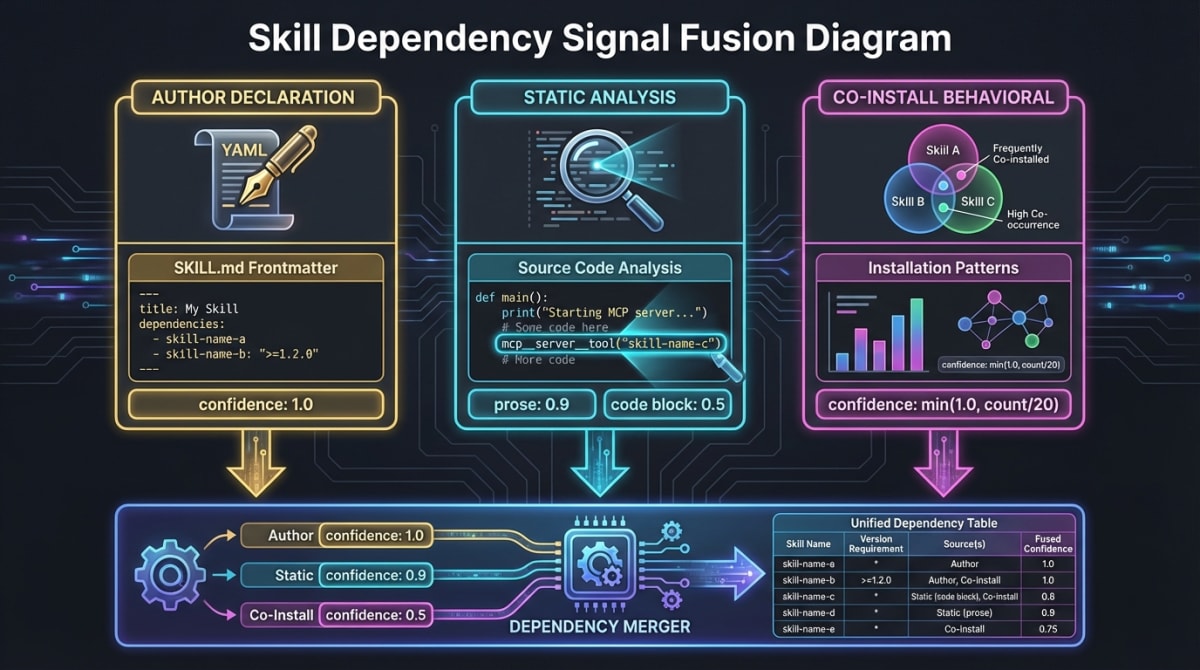
Dependency Intelligence doesn’t rely on a single source of truth. It triangulates from three independent signals, each with calibrated confidence scores.
Signal 1: Author Declaration (confidence: 1.0)
Authors declare dependencies directly in SKILL.md frontmatter using a structured dependencies block. This replaces the deprecated composes field with typed, versioned relationships:
dependencies:
  skills:
    - name: linear
      version: "*"
      type: hard
      reason: "Issue creation via Linear MCP"
  platform:
    mcp_servers:
      - name: linear
        required: true
  models:
    minimum: sonnet
    capabilities: ["tool_use"]
  environment:
    tools:
      - name: git-crypt
        required: false
        check: "git-crypt --version"
Declared dependencies always have confidence 1.0 — the author explicitly stated the requirement. Hard skill dependencies block installation with a clear message. Soft dependencies produce advisory warnings. This is real metadata, not a flat list.
Signal 2: Static MCP Reference Analysis (confidence: 0.5–0.9)
The McpReferenceExtractor scans skill content for mcp__server__tool patterns using regex:
mcp__([a-z][a-z0-9-]*)__([a-z][a-z0-9_]*)Every match extracts the server name and tool name. The extractor then assigns confidence based on where the reference appears:
- Prose (outside code blocks): 0.9 — the skill is describing what it does, high likelihood it actually calls this tool
- Code block (inside fenced blocks): 0.5 — could be an example, a template, or documentation rather than a live reference
This distinction matters. A skill that explains how to use Linear (mcp__linear__save_issue in a code example) is different from a skill that calls Linear directly. Both get tracked, but at different confidence levels. Input is capped at 100KB to prevent ReDoS.
Signal 3: Behavioral Co-Install Data (confidence: 0.0–1.0)
The CoInstallRepository tracks which skills are frequently installed together. When 15 out of 20 governance users also install the Linear skill, that behavioral signal carries weight — even if neither skill explicitly declares the other as a dependency.
Confidence ramps linearly: min(1.0, install_count / 20). A single co-install registers at 0.05; twenty co-installs reach full confidence. This prevents noisy early data from generating spurious recommendations while letting strong patterns surface over time.
How They Merge
The DependencyMerger combines all three sources with a clear priority: declared dependencies always win. If an author declares linear as a required MCP server and the static analyzer also detects mcp__linear__* references, the declared version is kept and the inferred duplicate is dropped.
| Source | Confidence | Trumps |
|---|---|---|
| Author declaration | 1.0 | Everything |
| Static analysis (prose) | 0.9 | Co-install |
| Static analysis (code block) | 0.5 | Nothing |
| Co-install behavioral | 0.0–1.0 (ramp) | Nothing |
The merged output writes to a skill_dependencies table in SQLite — one row per dependency, with type, target, version constraint, source, confidence, and JSON metadata. A unique index on (skill_id, dep_type, dep_target, dep_source) prevents duplicates while enabling reverse lookups: “show me every skill that depends on the Linear MCP server.”
The dependencies Block: What Authors Declare
The new frontmatter schema supports five dependency categories with explicit type discriminators:
dependencies:
  skills:           # skill-to-skill relationships
    - name: "author/skill-name"
      version: "^1.0.0"        # semver range
      type: hard | soft | peer  # hard blocks install, soft warns, peer suggests
      reason: "Why this is needed"

  platform:         # MCP and CLI requirements
    cli: ">=1.0.0"             # Claude Code CLI version
    mcp_servers:
      - name: linear
        package: "@anthropic/linear-mcp"
        required: true | false

  models:           # model requirements
    minimum: sonnet            # minimum model tier
    recommended: opus
    capabilities: ["tool_use", "vision"]
    context_window: 100000

  environment:      # tools, OS, runtime
    tools:
      - name: docker
        required: true
        check: "docker --version"
    os: ["darwin", "linux"]
    node: ">=20.0.0"

  conflicts:        # known incompatibilities
    - name: "author/conflicting-skill"
      reason: "Overlapping key bindings"
This schema maps to eleven database dep_type values: skill_hard, skill_soft, skill_peer, mcp_server, model_minimum, model_capability, env_tool, env_os, env_node, cli_version, and conflict. Each type drives different behavior — hard skill deps block, conflicts warn, environment deps surface check commands.
The Toolkit: Seven Tools, Two Audiences
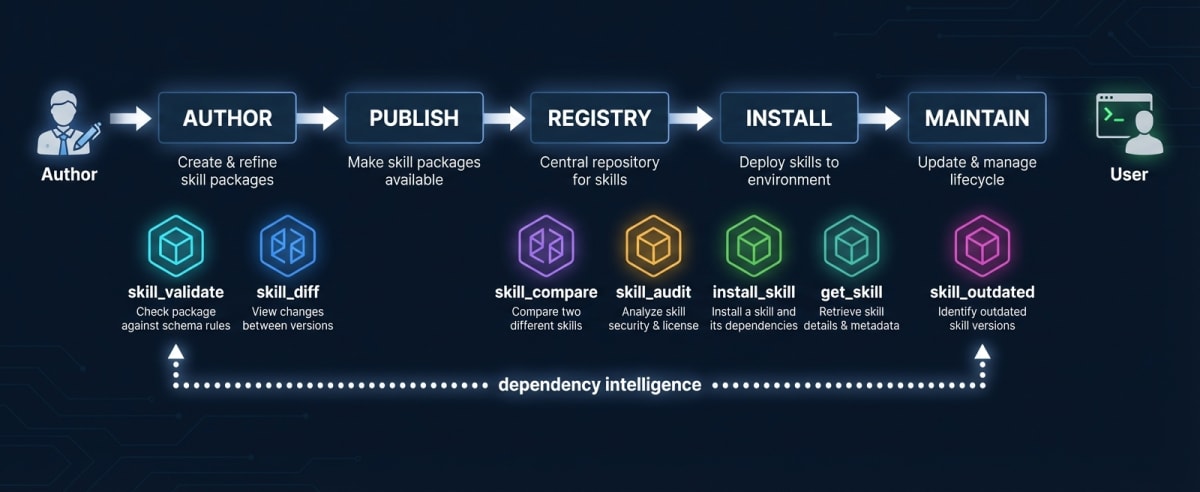
Dependency intelligence isn’t a single tool — it’s a layer that runs through the entire skill lifecycle. Seven MCP tools now participate, each surfacing the right information at the right moment.
For Authors: Catch Issues Before Publish
skill_validate is the first line of defense. Run it against any SKILL.md and it will flag:
- Deprecated
composesfield — suggests migration todependencies.skillswith explicittype: hard/soft/peer - Inferred MCP servers not declared — if your skill body references
mcp__linear__save_issueoutside code blocks but you haven’t declaredlinearindependencies.platform.mcp_servers, you’ll see: “Inferred MCP dependency: ‘linear’ (referenced in skill body). Consider declaring in dependencies.platform.mcp_servers.” - Malformed dependency blocks — structural issues in the frontmatter YAML
These are warnings, not blockers. Authors can publish without addressing them. But the signal is clear: declare your dependencies and your users will have a better experience.
skill_diff compares two versions of an installed skill section-by-section, with risk scoring based on the nature of each change. When the Dependencies section changes between versions, it surfaces in the diff — giving authors (and reviewers) visibility into how a skill’s requirements evolve across releases.
For Users: Understand Before You Install
get_skill returns the full dependency table for any skill in the registry — declared and inferred, with confidence scores and source labels. Before you install a skill, you can see exactly what it expects: which MCP servers it references, which skills it depends on, what model capabilities it assumes.
skill_compare puts two to five skills side by side and includes dependency counts in the comparison. If you’re choosing between two similar skills, the one with fewer external dependencies may be the simpler choice — or the one with more declared dependencies may be the more honest one. The comparison surfaces both.
install_skill now returns dependency intelligence in the install response:
dep_inferred_servers— MCP servers detected in the skill content (e.g.,["linear", "github"])dep_declared— the full author-declareddependenciesblockdep_warnings— alerts when referenced MCP servers may not be configured
The user doesn’t need to read through the skill’s markdown to understand its requirements. The information is right there in the response.
For Maintenance: Stay Current
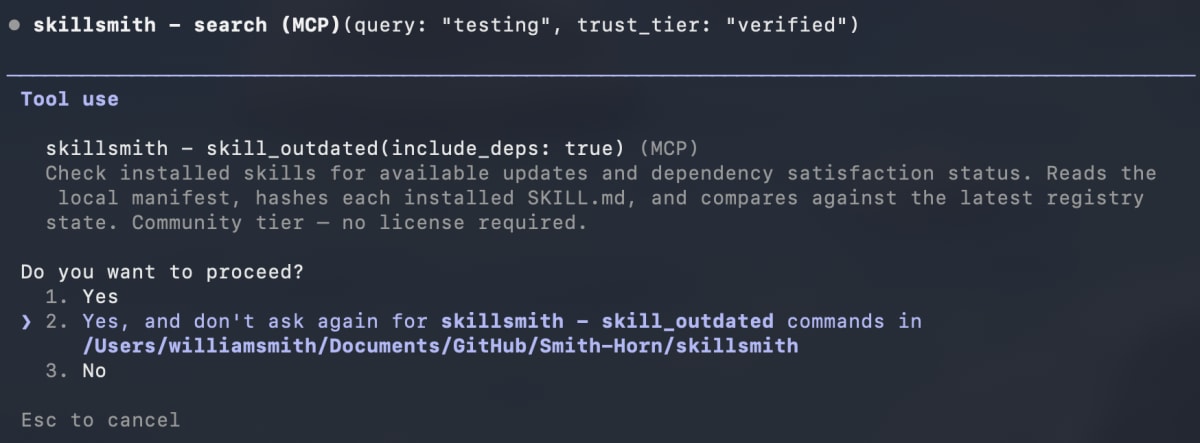
skill_outdated is a pull-based health check — the dependency equivalent of npm outdated. It reads the local skill manifest, hashes each installed SKILL.md, compares against the latest registry state, and checks dependency satisfaction:
{
  "skills": [
    {
      "id": "smith-horn/governance",
      "installed_hash": "a1b2c3d4",
      "latest_hash": "e5f6g7h8",
      "status": "outdated",
      "semver": "1.4.1",
      "dependencies": {
        "total": 2,
        "satisfied": ["mcp_server:linear"],
        "missing": []
      }
    }
  ],
  "summary": {
    "total_installed": 8,
    "outdated": 1,
    "up_to_date": 6,
    "unknown": 1,
    "missing_deps": 0
  }
}
Skill-type dependencies (skill_hard, skill_soft, skill_peer) are verified against locally installed skill IDs — if the dependency is installed, it’s satisfied; if not, it’s missing. MCP server and environment dependencies are marked satisfied on a best-effort basis since Skillsmith can’t verify runtime configuration.
skill_audit (Team tier) complements dependency intelligence with security advisory checks. It doesn’t track dependencies directly, but when a skill version has a known vulnerability, the audit flags it — and the dependency graph tells you which other skills are affected downstream.
Tier Availability
| Tool | Tier | License Required |
|---|---|---|
skill_validate |
Community | No |
skill_outdated |
Community | No |
install_skill (dep intel) |
Community | No |
get_skill (dep intel) |
Community | No |
skill_compare (dep counts) |
Community | No |
skill_diff |
Individual | Yes |
skill_audit |
Team | Yes |
Design Decisions: Why We Didn’t Build a Resolver
The most common question: why not auto-install missing dependencies?
Three reasons.
Control. Skills are markdown files that get loaded into an AI agent’s system prompt. Auto-installing a dependency means silently adding instructions to the agent’s context. Users should know what’s being added and why. Advisory warnings preserve user agency in a way that automatic resolution does not.
Trust boundaries. A skill declaring a hard dependency on another skill is a trust assertion — “I need this to function.” Auto-resolving that assertion would mean one skill author can trigger installs of another author’s code. Even with trust-tier verification, this crosses a boundary we’re not comfortable crossing automatically.
Scope. Skillsmith is an intelligence layer, not a package manager. npm, pip, and cargo have decades of resolver engineering behind them — dependency hell, version conflicts, diamond dependencies, platform-specific overrides. We’d rather surface good information and let users make decisions than build a resolver that makes wrong decisions silently.
The rule: hard declared dependencies block installs with clear messages. Everything else is advisory. Users always see the full picture; they’re never surprised by what was installed or why something failed.
What’s Next
Dependency Intelligence is the data layer. The next sprint builds policy and automation surfaces on top:
- CycloneDX AI-BOM export — dependency graph exported as a standard software bill of materials, useful for compliance audits and organizational governance
dependency_policyconfiguration — Team and Enterprise tiers will support strict/advisory/ignore policies, letting organizations enforce dependency standards across their skill portfolio- GitHub Action PR comments — when a PR modifies SKILL.md in ways that change the dependency graph, automated comments will surface the diff for review
The foundation is in place: three signal sources, calibrated confidence, a schema that supports eleven dependency types, and seven tools that surface the right information at every stage of the skill lifecycle. Every skill installed from this point forward gets a dependency profile — declared, inferred, or both.
Dependency Intelligence is available now for all Skillsmith users. Run skill_outdated with include_deps: true to check your installed skills, or skill_validate on any SKILL.md to see what we infer. For skill authors: add a dependencies block to your SKILL.md frontmatter — your users will thank you.